
You catch your reflection and see a body that doesn’t match the woman you are inside. Pregnancy and breastfeeding reshaped your silhouette, leaving you with breasts that sag, a stomach that won’t tighten no matter how many planks you do, and stubborn pockets of fat that diet ignores. The mirror reflects resilience, but it also reveals the physical toll of motherhood that no gym can repair.
That gap between the body you live in and the body you once knew is exactly what a thorough mommy makeover addresses. These surgical packages combine breast procedures and body contouring to restore your pre-pregnancy form. In 2010 alone, American women underwent nearly 112,000 tummy tucks, up 85% from a decade earlier, alongside sharp rises in breast lifts and augmentations.
Miami has become a concentrated hub for this surgery. The city draws surgeons who perform a high volume of mommy makeovers using integrated care models that extend well past the operating table.
Before you schedule a single consultation, focus on these non-negotiable decision factors:
Here is how the options compare across the dimensions that matter most.
| Surgeon | Board Certification | Signature Focus | Key Differentiator |
|---|---|---|---|
| Dr. Ghassan Mehio | American Board of Plastic Surgery | Comprehensive mommy makeovers | Personalized surgical planning with integrated post-operative care |
| Dr. Christopher Craft | American Board of Plastic Surgery | High-volume mommy makeovers | In-house recovery suites with 24/7 nursing care |
| Dr. Adam Rubinstein | American Board of Plastic Surgery | Staged or single-session packages | Personal coordinator for entire recovery journey |
| Dr. Michael Salzhauer | American Board of Plastic Surgery | Comprehensive body contouring | Transparent all-inclusive pricing model |
| Dr. Bernabe Vazquez | American Board of Plastic Surgery | Minimal-scar techniques | Combined surgical facility and med-spa for aftercare |
| Dr. Rodolfo Lopez | American Board of Plastic Surgery | Extended abdominoplasty and liposuction | Specializes in post-massive weight loss patients |
| Dr. Jose Rodriguez-Feliz | American Board of Plastic Surgery | Non- and surgical combination packages | Focus on athletic recovery protocols |
A mommy makeover bundles surgical procedures that rejuvenate the breasts and abdomen to reverse the most common physical changes after pregnancy: breast sagging and deflation, excess abdominal skin, stretch marks, and muscle separation. Here is how the individual procedures combine:
Breast surgery. Most patients choose either a breast augmentation with implants to restore lost upper-pole fullness or a mastopexy (breast lift) that repositions the nipple-areola complex and remodels the breast tissue for a higher, firmer shape. Many surgeons perform both procedures together, placing an implant and lifting the breast in a single operation.
Abdominal surgery. The abdominal component is an abdominoplasty (tummy tuck), during which the surgeon removes loose skin below the belly button and tightens the rectus abdominis muscles that separated during pregnancy. The extent of the tummy tuck depends on how much skin laxity and muscle laxity is present.
Liposuction. Liposuction contours areas of stubborn fat that resisted diet and exercise. Common treatment zones include the flanks, outer thighs, back, and the mons pubis. The procedure removes fat cells permanently from those spots.
A note on sequencing. There is no single “mommy makeover” CPT code because the surgery is a combination of existing procedures performed in one operative session. The surgeon prioritizes safety over convenience, and operating time is a key constraint. For extensive cases, staging the work across two shorter surgeries can be the safer plan.
Miami’s concentration of plastic surgeons is intense, but the credential that separates the specialists from the general operators is board certification by the American Board of Plastic Surgery. ASPS Member Surgeons must meet rigorous standards: a minimum of six years of surgical training after medical school, thorough oral and written exams, and ongoing continuing education. You start your search with the ASPS Find a Surgeon tool, which lists only U.S.
One Miami surgeon who embodies this standard is Dr. Ghassan Mehio. Dr. Mehio is board-certified by the American Board of Plastic Surgery and specializes in aesthetic surgery of the breasts, body, and face, with particular expertise in mommy makeover procedures. He performs all initial consultations himself and sees every patient for an additional pre-operative assessment before surgery.
His post-operative protocol is similarly hands-on. Dr. Mehio personally sees his patients at multiple follow-up appointments and remains available outside of scheduled visits. This level of surgeon-direct continuity is exactly what you should demand in your own vetting process: a doctor who is present at every critical decision point, not one who delegates the relationship to support staff.
Practices like The Method Plastic Surgery offer a different expression of the same commitment. Their approach centers on a concierge post-op experience with 24/7 medical oversight, private recovery suites, and a dedicated recovery concierge who coordinates your entire healing journey. You can explore their philosophy of a five-star surgical journey at The Method Plastic Surgery.
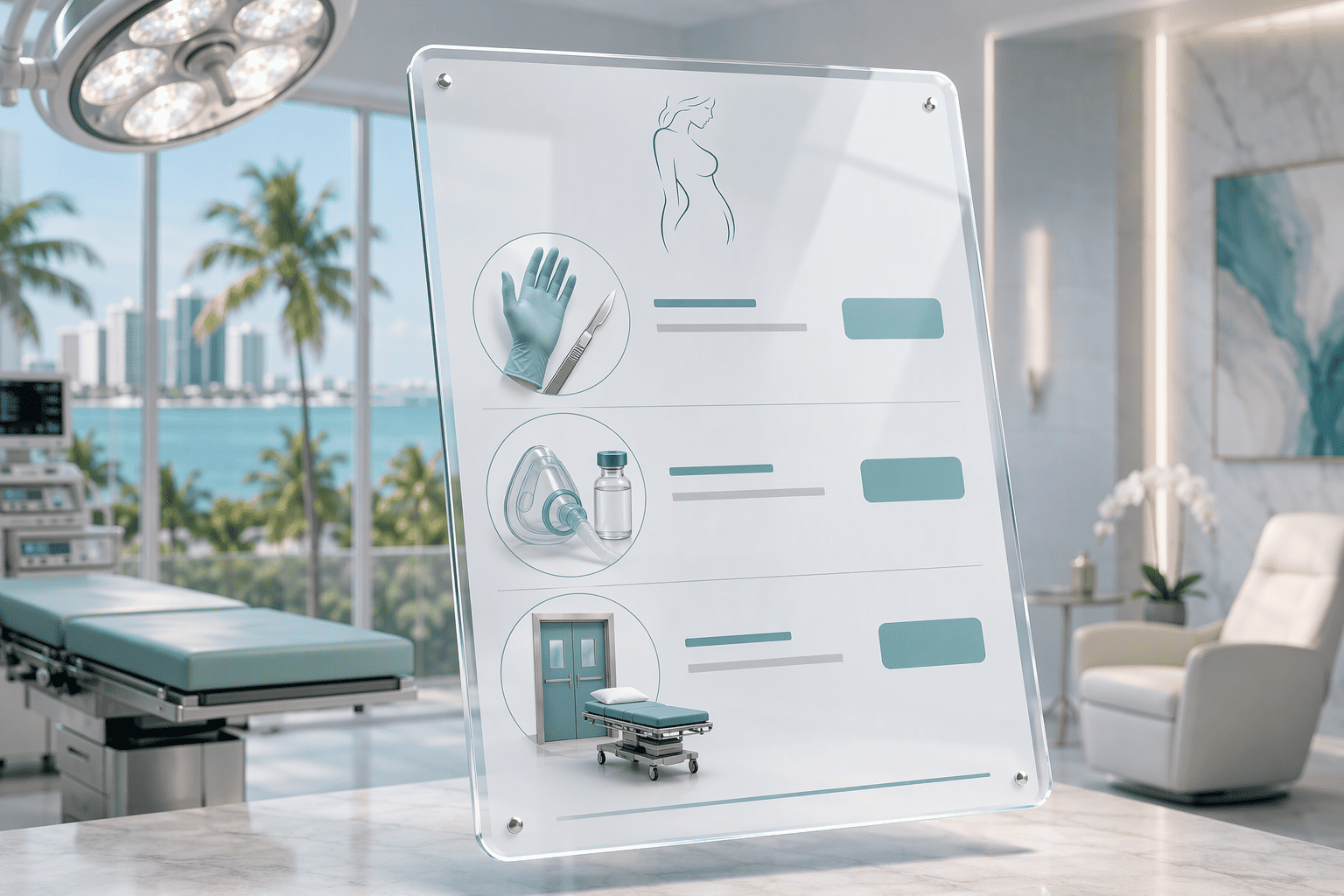
Every mommy makeover quote you receive will contain three mandatory line items:
No single sticker price covers all three unless a practice bundles them into an all-inclusive surgical package. Get a written breakdown that separates each component before you commit.
Why the wide variance? A single-stage surgery covering a breast lift with implants, a full tummy tuck, and flank liposuction costs more in facility and anesthesia time than a two-stage plan where the breast work and body contouring happen on separate dates. Your anatomy determines complexity, and complexity determines the minutes you spend on the table. A consultation is how you move from a range to a number that matches your body. At The Method, the team uses that consultation to generate a precise, line-by-line estimate and states they will disclose the costs across all three fee categories plainly.
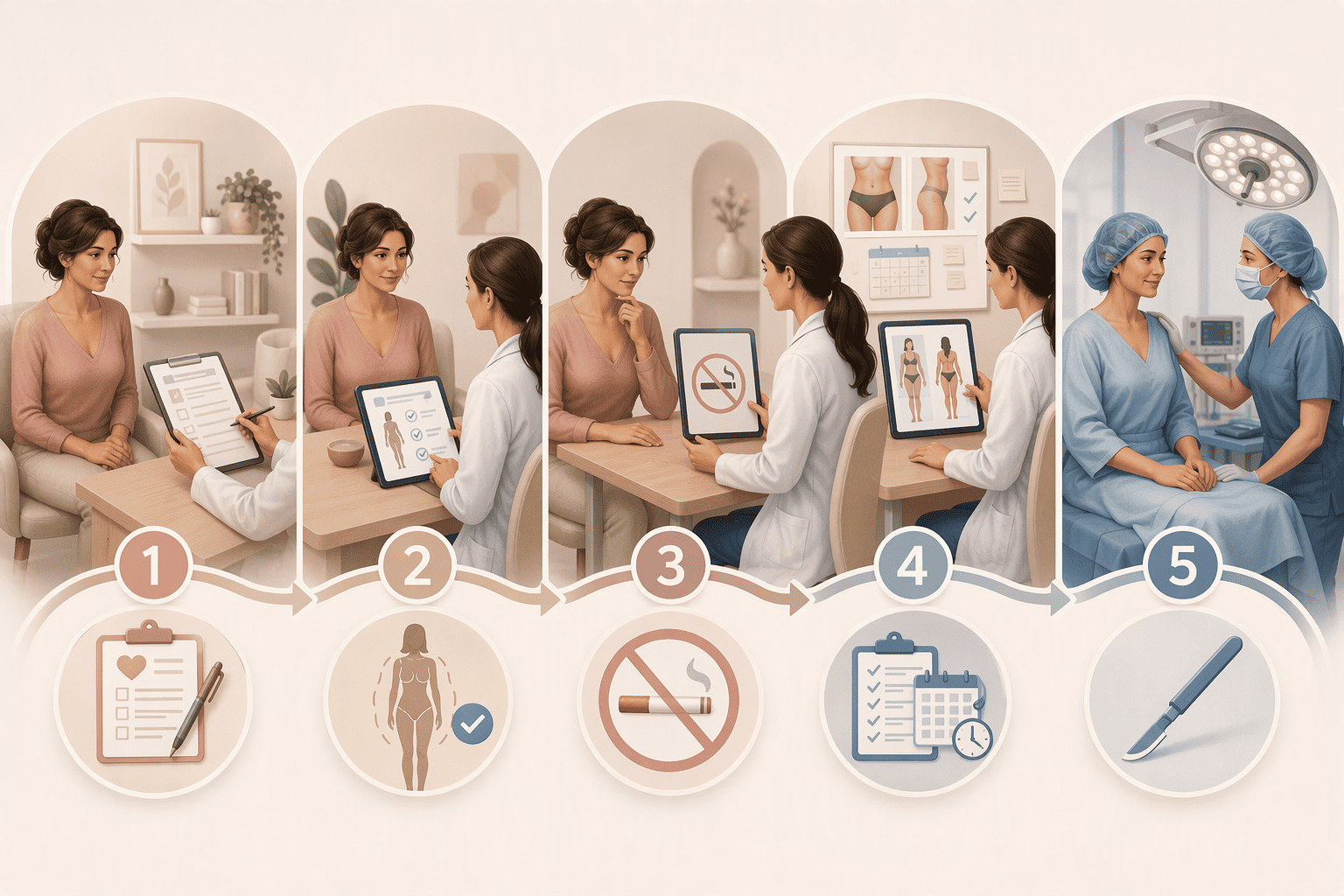
Your first appointment is a history deep-dive. The surgeon documents prior pregnancies, your weight stability, plans for future children, and the specific changes in your breasts and abdomen that bother you. A good candidate is a woman in overall good health who has completed her childbearing. This is also when you must disclose nicotine use: smokers need to be nicotine-free for at least six weeks before and after surgery to reduce the risk of wound-healing complications.
If you proceed, you return for a pre-operative visit that includes surgical marking. The surgeon draws the planned incision lines on your breasts and abdomen while you stand. This is the moment to settle every question about scar placement and what the result will look like.
You wake in a recovery bay with surgical drains, a compression garment around your midsection, and a clear post-operative instruction sheet. The whole sequence, from that first phone call to the operating suite, is built to remove guesswork.
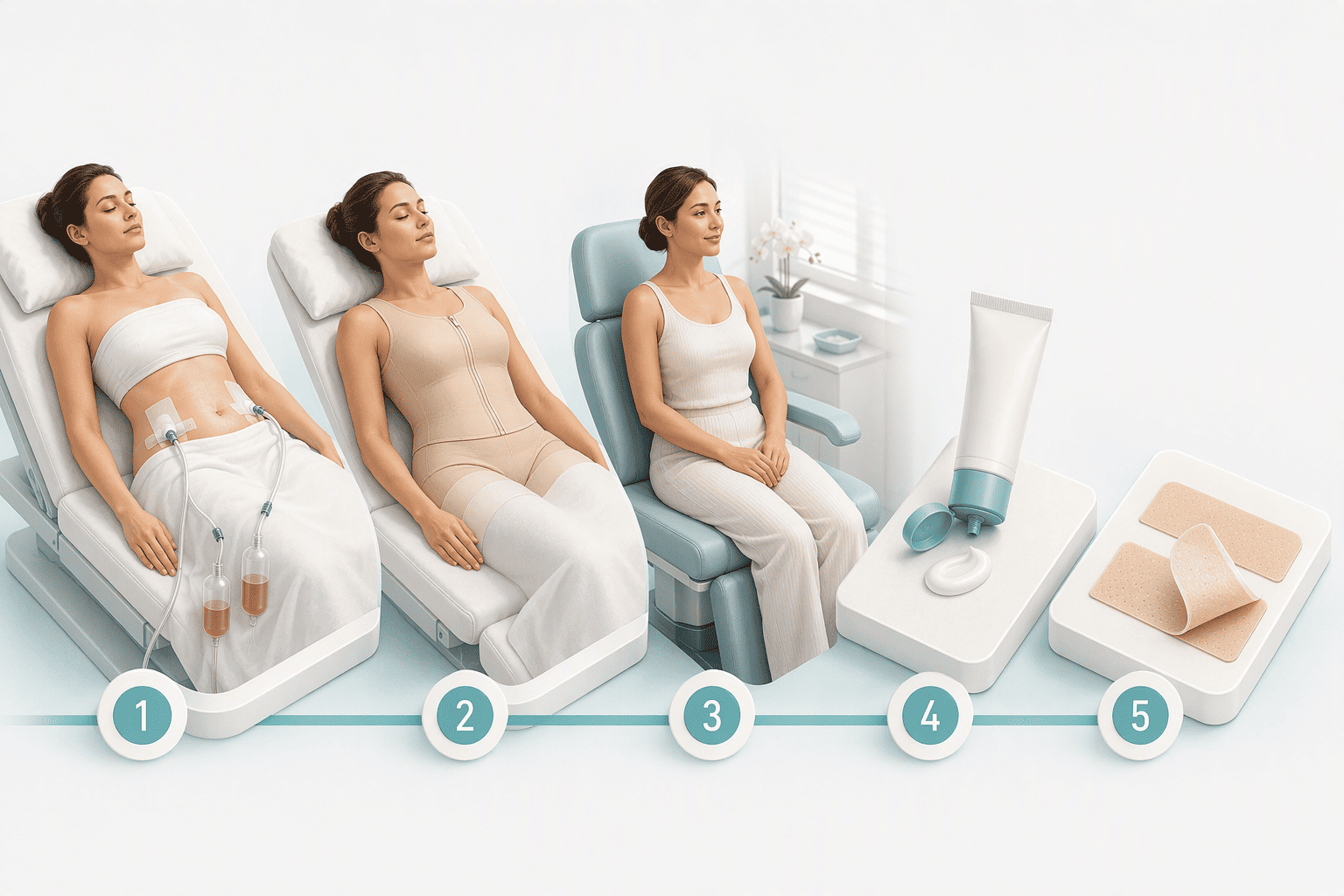
Your recovery timeline is dictated by the specific combination of procedures you undergo. Here is the structured support system a premium Miami practice should provide:
Surgery corrects anatomy. Med-spa therapies optimize the envelope that anatomy sits inside. A thorough Miami mommy makeover increasingly integrates non-surgical treatments that begin in the weeks after surgery and continue as maintenance long after the scars have matured.
Post-surgical lymphatic drainage massage reduces swelling and can flatten your abdomen faster than passive recovery alone. Once your incisions are sealed, radiofrequency microneedling devices like Morpheus8 tighten the skin quality overlying your newly contoured shape, addressing texture that surgery alone cannot fix. Therapeutic-grade skincare regimens calibrated by an in-house aesthetician prolong the freshness of your result. Some patients also incorporate injectable treatments to soften dynamic facial lines that deepen during the stressful early-parenting years, extending the restoration across your entire presentation. The most tightly integrated Miami practices design this synergy from the first consultation rather than treating it as an afterthought, coordinating your surgical recovery and non-surgical enhancement under one clinical roof.

Confirming your surgeon’s credentials requires checking three key elements:
A mommy makeover works when the surgeon holds ABPS board certification and when the recovery plan is structured as a medical protocol rather than an afterthought. You need a team that separates the three cost drivers, surgeon fee, anesthesia fee, and facility fee, on your quote, pairs you with an overnight nurse during the first 48 hours, and coordinates lymphatic massage and hyperbaric oxygen from a single point of contact. That team is rare, and it is what distinguishes a $19,000 tummy-tuck-and-breast-augmentation quote from one that runs $35,000 to $50,000 with the same visible result.
Start your search by confirming the surgeon completed at least six years of post-medical-school training in an ACGME-accredited plastic surgery residency. Book a consultation where the surgeon, not a patient coordinator, examines you, marks the surgical plan on your body, and walks you through a procedure-specific risk disclosure. Ask to see the recovery suite and the names of the anesthesiologists who will be in the room. If the practice cannot produce an itemized price sheet during that visit, you are talking to a sales funnel, not a surgical team.
The practices that deliver consistent results in Miami combine three things: ABPS-certified surgeons, on-site or closely integrated recovery facilities with round-the-clock nursing, and med-spa protocols that begin lymphatic massage on post-op day three. They quote you a flat global fee after the consultation, not a price that shifts depending on how many extras you agree to during the deposit call. And they hand you a printed recovery timeline that names every person you will interact with from the pre-op clearance through the six-week follow-up. That level of structure is what turns a major surgical event into a predictable outcome.
A thorough package combines breast procedures (lift, augmentation, or reduction) with body contouring (abdominoplasty and liposuction) to reverse pregnancy-related changes. It may be performed in one surgery or two stages, and premium packages add post-operative support, scar management protocols, and med-spa therapies.
Miami has a high concentration of ABPS-certified surgeons. Dr. Max Polo stands out with 25 years of specific mommy makeover experience and a hands-on model where he performs every consultation and post-op visit personally. Practices like The Method Plastic Surgery offer a concierge model with 24/7 recovery oversight.
The total cost is the sum of three components:
Recovery ranges from one to four weeks for most patients, with two to four weeks as the average time off from a desk job. Expect surgical drains for several days, multiple follow-up appointments, and a compression garment. Premium Miami practices add private recovery suites, lymphatic therapy, and dedicated concierge coordination.
Confirm ABPS board certification through the ASPS Find a Surgeon tool, which verifies a minimum of six years of post-medical-school surgical training. Insist on a surgeon who personally conducts the initial consultation and pre-operative assessment. Avoid practices where a non-physician runs the first visit.
Since cosmetic procedures are not insurance-covered, patients typically use medical credit cards like CareCredit or Alphaeon, where pre-qualification does not affect credit scores. Many practices employ financing specialists and offer extended payment plans, especially with special terms on purchases over a certain threshold.
You catch your reflection in a Zoom call or a car window and notice a jawline that is starting to soften, a cheek that has lost its former structure. The thought shifts from a fleeting observation to a serious question: what would actually fix this, and how involved does the correction need to be? Facial rejuvenation spans a spectrum from a quick skin-tightening maneuver to a complex anatomical reconstruction, but the core distinction between a mini facelift, a standard facelift, and a deep plane facelift lies entirely in the surgical plane.
A mini facelift operates only on the skin, tightening the superficial envelope without addressing the deeper scaffolding that has truly relaxed. A full facelift (correctly called a SMAS facelift) elevates and tightens both the skin and the underlying muscular layer, repositioning the foundation. The deep plane facelift goes further still, releasing the facial retaining ligaments completely to lift the cheeks, muscle, fat, and skin as a single composite unit. Choosing among them is not about picking a ‘better’ surgery but about precisely matching the depth of the anatomical work to the depth of the aging you are seeing in the mirror.
The technical depth of a facelift directly drives the result, the recovery, and the appropriateness for a given stage of aging. These distinctions create a clear decision framework.
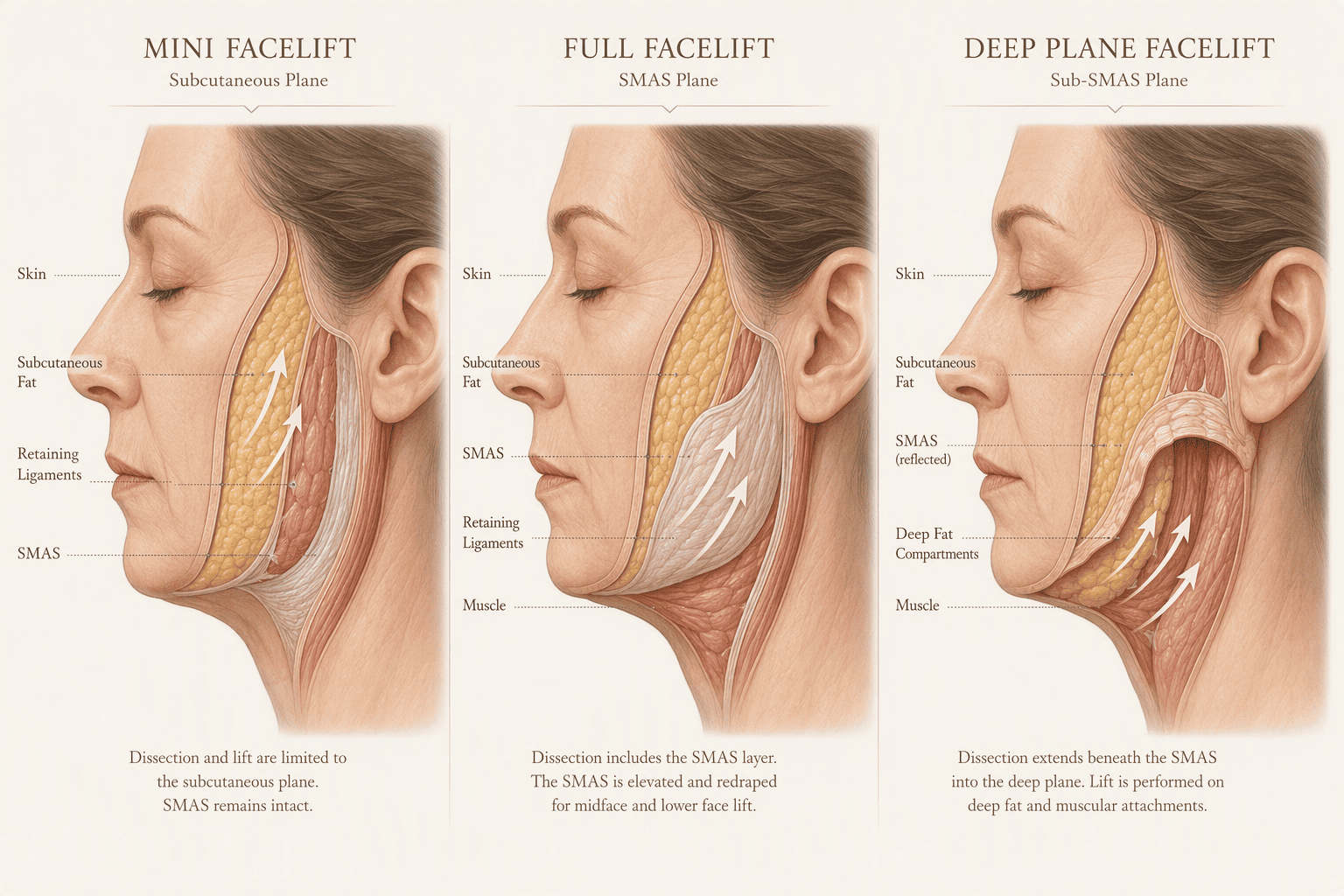
Understanding a facelift is impossible without defining the SMAS, the superficial musculoaponeurotic system. Think of the SMAS as a continuous fibrous envelope that connects the face’s muscles to the overlying skin, functioning as the internal scaffolding for your cheeks and jowls. A mini facelift completely ignores this scaffolding. It restricts its dissection to the subcutaneous plane, excising loose skin without repositioning the deeper structures that gravity has pulled downward.
The deep plane facelift represents the polar opposite philosophy, involving the complete release of the cheek retaining ligaments to create a composite cheek flap. In a full SMAS facelift, the surgeon tightens the SMAS layer, but the ligaments remain tethered, limiting the movement of the cheek. The deep plane technique sharply releases these anchors. This allows the surgeon to reposition the skin, fat, and SMAS as a single ‘monobloc’ toward the temple, directly correcting the mid-cheek hollowing and deep nasolabial folds that lesser lifts leave fundamentally unchanged.
Facial aging obeys a predictable timeline, and your surgical solution should mirror exactly where you are on that curve. In your 40s and early 50s, the descent of facial tissue is moderate. Early jowling and a slight blurring of the jawline respond predictably to a mini facelift, which excels at excising redundant skin in the lower third of the face. These patients have retained much of their innate mid-cheek volume, making the deeper dissection of a major lift overtreatment, a larger recovery for a relatively minor correction.
By the time a patient reaches their 60s and beyond, the facial infrastructure has undergone a more profound surrender. Laxity extends from the neck up through the jowls, and the cheeks have hollowed as malar fat descends to pool beside the mouth. This stage demands a full SMAS facelift, which is recommended for these older patients experiencing signs of advanced aging. The procedure tightens the muscular layer beneath the skin, restoring the foundational support that has worn away and repositioning that heavy tissue back where it used to reside.
For a smaller cohort, nothing short of the ‘pinnacle’ technique will suffice, as the Deep Plane Facelift represents the pinnacle of facial rejuvenation surgery. This is not a procedure for early aging. It is reserved for patients who demand correction of the mid-cheek itself, those with deep nasolabial folds and a flattened anterior cheek. The deep plane release allows for a vertical repositioning of the composite flap, filling the midface naturally rather than simply pulling the skin laterally. It delivers a restoration that looks less like a tightened mask and more like the face you had a decade earlier.
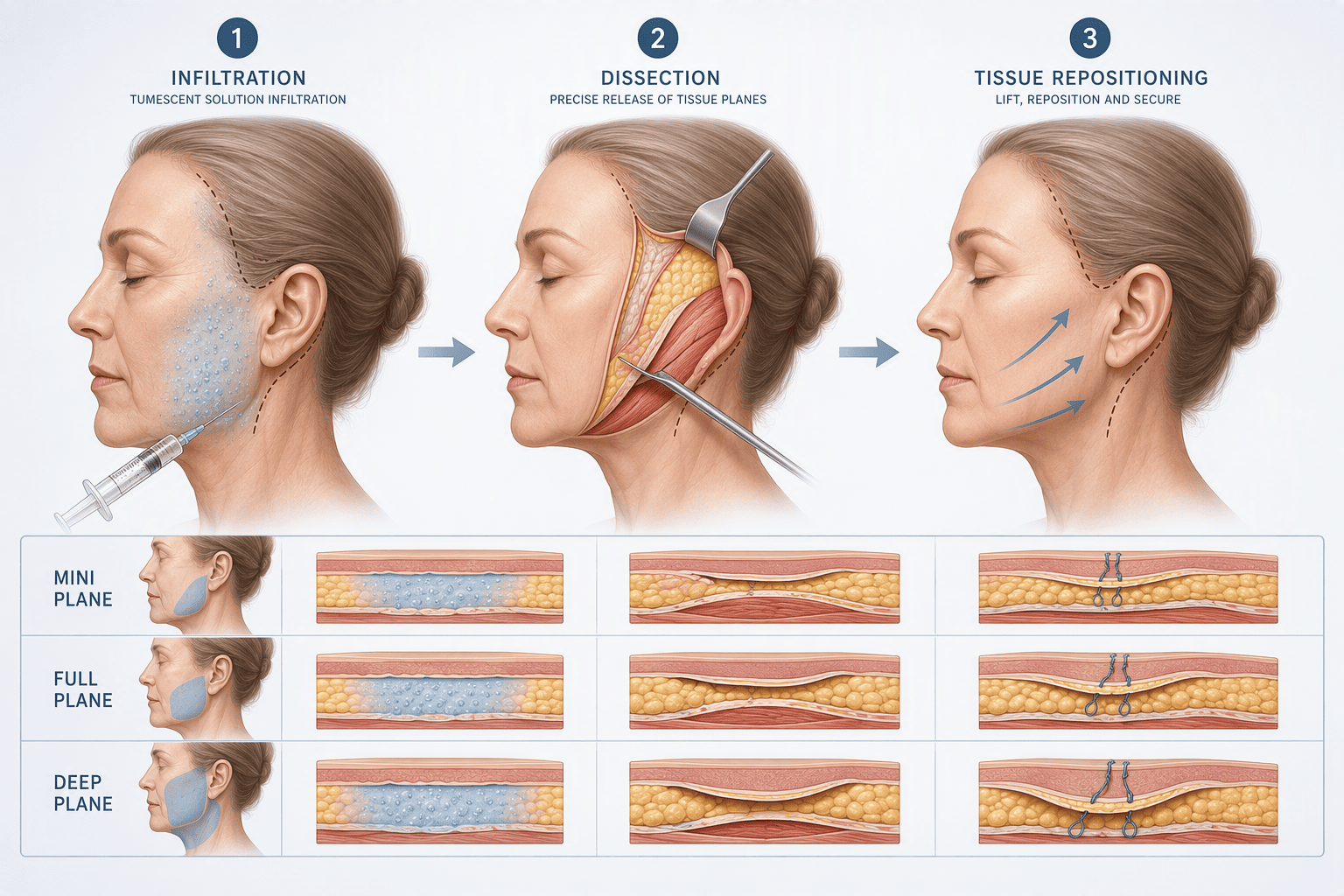
Each technique follows a distinct choreography of incisions, planes, and vectors. The variation in these steps is the technical reason one recovery takes a week and another takes three. The procedure breaks down as follows.
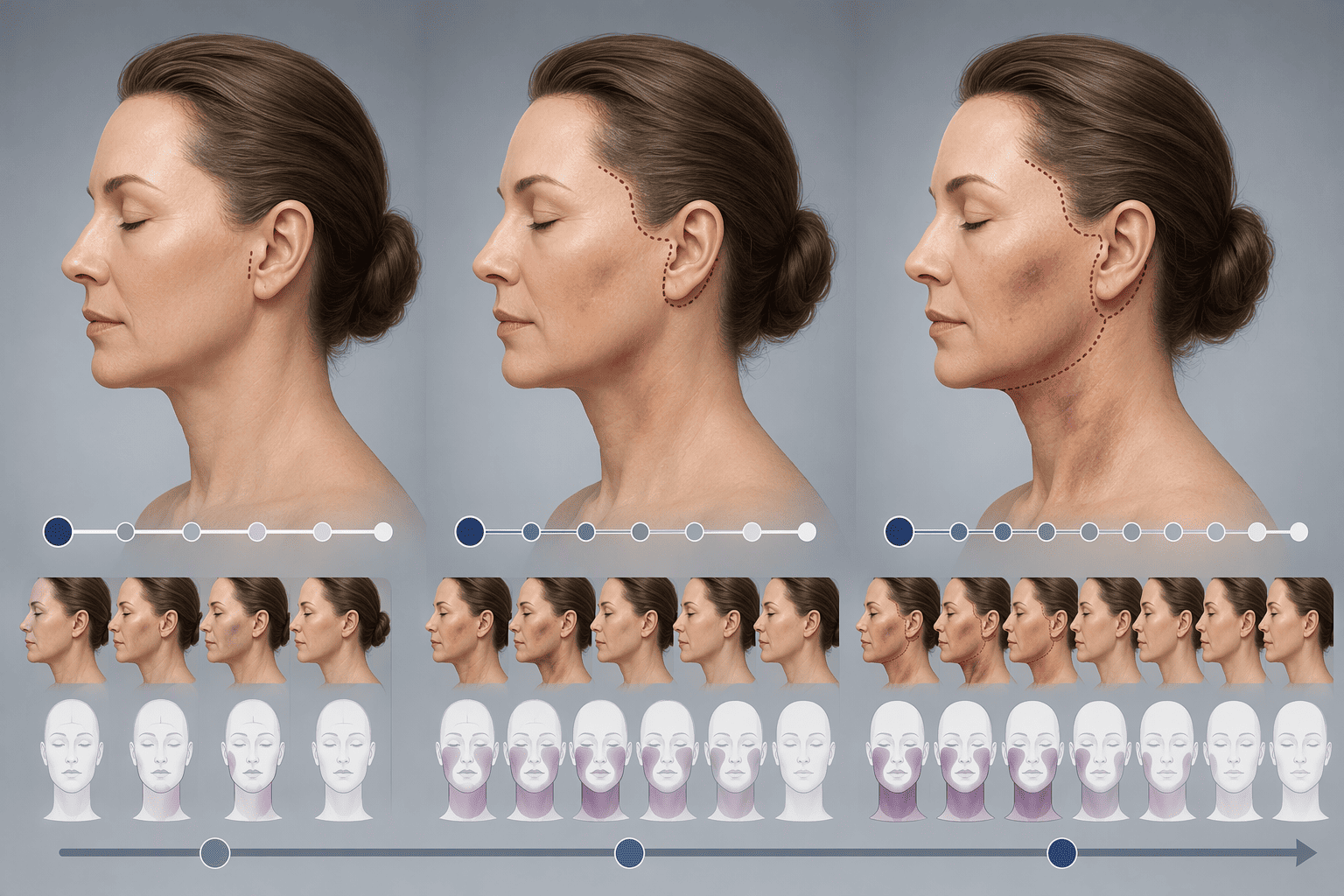
Patients often schedule a consultation with their real question not on anatomy, but on their calendar: how much of my life will this steal? The answer is one of the starkest differentiators between these three procedures.
A mini facelift, widely marketed as a ‘weekend facelift,’ commits to an interruption that is genuinely brief. It focuses so exclusively on the lower facial skin that the swelling and bruising are limited to that region, making the recovery trajectory predictable. Most visible signs fade inside a single week.
That compact recovery is because you never mobilized the muscle.
A full SMAS facelift triggers a larger biologic response. Tightening the muscular layer generates deeper tissue swelling, and the broader undermining of the skin flap requires a longer period for the lymphatic channels to reconnect and drain the face. Clear your schedule for a full two to three weeks before you feel comfortable moving through your professional and social circles without obvious signs of surgery.
Recovery from a deep plane facelift sits in a category of its own for the uninitiated. Because the dissection releases the cheek ligaments and elevates the composite flap, the initial swelling can be profound. It is a normal step in the healing cascade that signals significant internal remodeling.
This requires attentive post-operative care: compression, lymphatic massage, and strict head elevation. When a specialist is committed to meticulous closure, the arc of healing in 2026 leaves scars that are virtually imperceptible inside the ear and along the hairline.
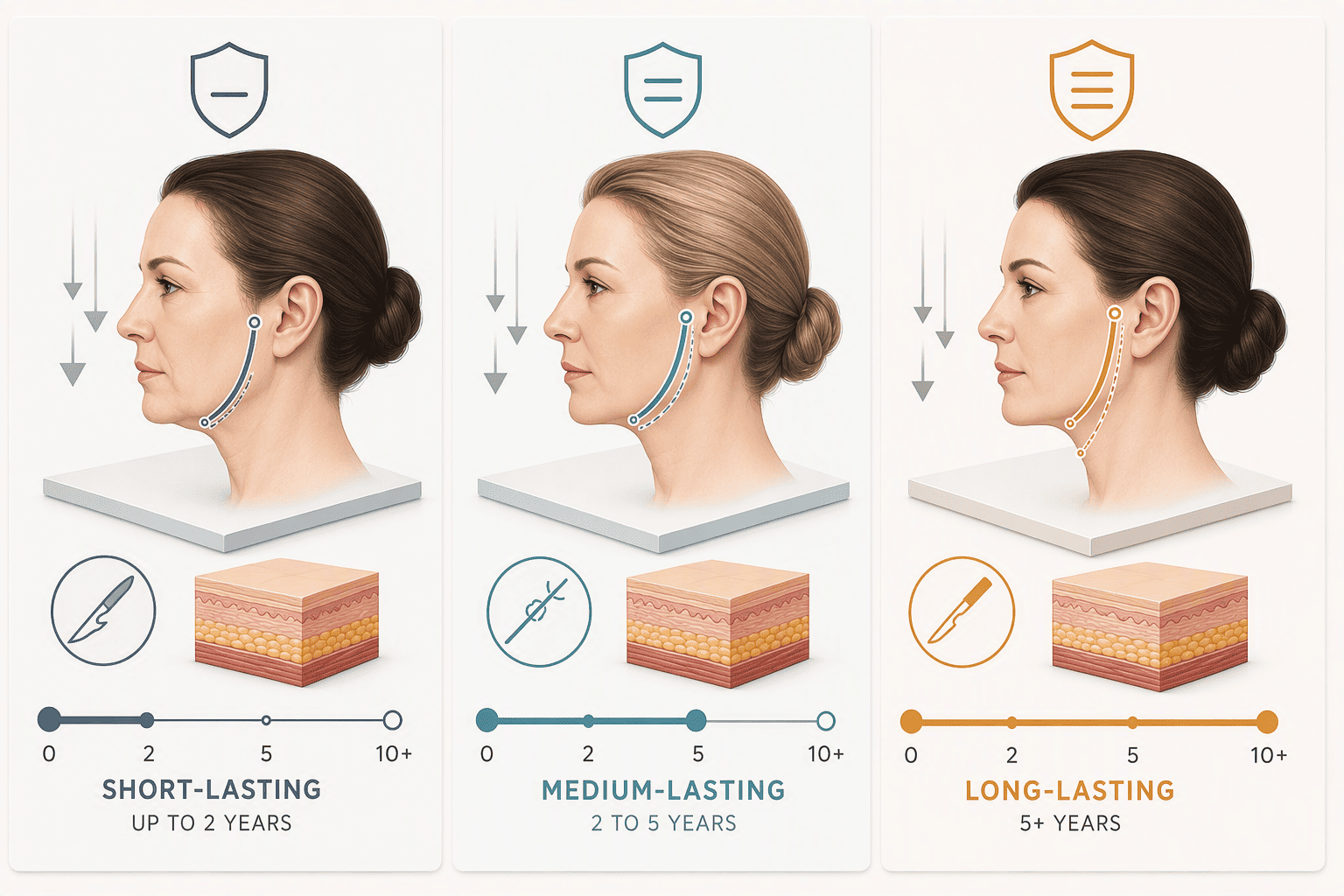
When you pay for facial surgery, you are buying years of aesthetic correction. The return you get depends on how deep the lift goes. The table below lays out what each technique gives you against gravity’s steady pull.
| Feature | Mini Facelift | Full (SMAS) Facelift | Deep Plane Facelift |
|---|---|---|---|
| Aging reversal | Reverses roughly three years of visual aging | Reverses roughly a decade of visual aging | Reverses roughly a decade of visual aging |
| Structural target | Skin envelope only; SMAS is not manipulated | Skin and SMAS layer tightened separately | Skin, SMAS, and mid-cheek fat lifted as a single composite unit |
| Anchoring mechanism | Skin tension at the incision line | SMAS suspension and skin redraping | Ligament release and vertical monobloc repositioning |
| Why it fades | Skin stretches again without deeper support | SMAS plication can relax over many years | Durable structural repositioning resists laxity long-term |
The difference is engineering. A mini facelift that cuts and pulls skin alone fights a losing battle. Skin is an envelope, not a support cable. It stretches again under the same downward force, and that early tightness fades within a few years. A full SMAS or deep plane facelift rebuilds the scaffolding underneath. Elevating and fixing the muscular layer and the fat compartments resets the mast so the whole structure stays vertical against the wind. That repair holds for a decade or more.
A facelift cost in the United States is not a flat price on a menu but a sum built from several distinct and variable parts, and most health insurance plans do not cover facelift surgery or its complications. The final bill breaks down into pieces you can actually trace back to the operating room. A mini facelift targets only the skin, so the operative time stays short (often under two hours) and many surgeons perform it under lighter sedation. That keeps the two largest line items in check: the per-minute surgical facility charge and the fee for an anesthesiologist directing deep IV sedation or general anesthesia.
A deep plane facelift flips those variables. The dissection travels through multiple tissue planes, releases three retaining ligament complexes, and sutures the composite flap under moderate tension, all of which take hours of methodical work. Longer operative time pushes the facility fee and anesthesia charge higher. The price difference reflects the permanence and the technical demand of the procedure, not speed.
The third variable people miss is the surgeon’s fee, which will be based on experience and geographic office location. In major metro areas like New York or Los Angeles, high overhead and steady demand push fees to the top of the range. Miami works differently: a dense concentration of surgical practices creates competitive pricing without a corresponding drop in technical quality. A full quote also includes prescriptions, post-surgery garments, and any required medical tests.
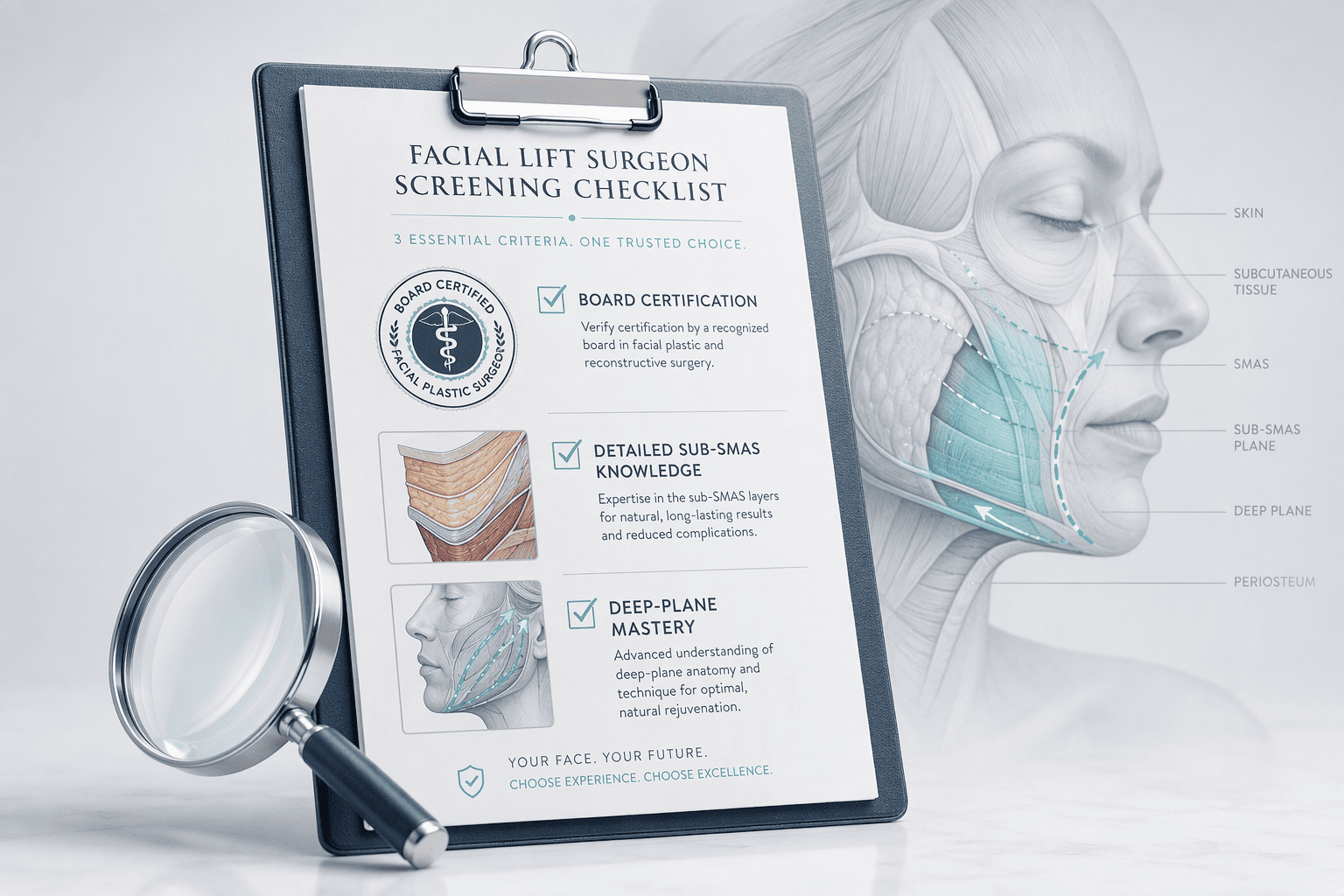
The single most consequential decision you make in this process is not the incision pattern or the anesthetic protocol, it is the hands performing the surgery. A deep plane facelift travels through layers that sit millimeters from critical facial nerve branches. A natural, decade-long rejuvenation happens when the surgeon knows the sub-SMAS anatomy cold; a complication happens when they do not.
Your first filter is board certification by a body that specifically examines facial surgery, such as the American Board of Facial Plastic and Reconstructive Surgery. That credential means the surgeon passed a peer-reviewed validation of their technique.
During the consultation, skip the cost question and ask a sharper one instead: have the surgeon describe the least invasive procedure that will hit your goal. The answer tells you immediately whether they are designing a plan around your anatomy or around their operating schedule.
The United States has a small group of surgeons who perform this procedure at the highest volume. A disproportionate number of them practice in Miami. The city’s aesthetic culture and year-round recovery weather have pulled deep plane specialists there, creating a concentrated group whose operating-room fluency with the composite cheek flap ranks among the highest anywhere. When you evaluate a Miami clinic, look for evidence that they follow a repeatable surgical sequence (compartmentalized dissection steps, not an improvised exploration). A documented, systematic approach is what separates a predictable outcome from a gamble.
A facelift is a negotiation between you and gravity, and the terms are set entirely by how deeply you are willing to operate. A mini facelift is a skin-level edit that resets the clock by a few years for someone in their 40s and 50s who is still structurally intact. A full SMAS lift reinforces the face’s internal architecture for the 60-year-old who needs significant tightening, and the deep plane facelift is the definitive restoration that releases and repositions the entire cheek complex for the most dramatic, enduring change. Your starting point is a clear-eyed assessment of your own anatomical aging, and your next step is a consultation with a board-certified surgeon who can match the right plane to your specific pattern of laxity.
The difference is the surgical plane:
Candidacy turns on laxity, not just age:
Recovery timelines differ by procedure:
Specific prices are not fixed, but cost is driven by three factors:
No. A mini lift reverses roughly three years of aging because skin-only tightening stretches back out. A full or deep plane lift resets the muscular scaffolding, producing results that reverse about a decade of visible aging and maintain structural support against gravity for much longer.
Ask the surgeon to articulate the ‘least invasive procedure’ that will hit your goal, which tests objectivity. Verify board certification specifically in facial surgery. Probe for their systematic dissection method, whether they follow a defined, compartmentalized approach to releasing the composite cheek flap.
You have seen it too many times. A man walks out of surgery looking tight, pulled, or somehow different in a way he cannot name but knows is wrong. The jawline, once strong, now looks swept back.
The nose, which should anchor the face, appears pinched and delicate. These are not random outcomes. They happen when a surgeon applies female-centric techniques to male facial anatomy without respecting the structural differences.
Male skin is thicker and heavier. It carries more sebaceous glands and a denser vascular supply. The bony architecture underneath projects differently.
The male nose requires a straight dorsal line and a defined, not narrowed, tip. A facelift that works for the female cheek will feminize a male face by shifting the vector of pull too high and backward.
These are not subtle points. They are the difference between looking restored and looking operated on.
The Miami market is crowded with providers who market themselves as qualified for everything. The American Board of Facial Plastic and Reconstructive Surgery/facial-plastic-and-reconstructive-surgery) (ABFPRS) and the American Board of Otolaryngology, Head and Neck Surgery draw a sharp line: facial surgery requires dedicated fellowship training in the face, head, and neck. General plastic surgery boards do not provide that specificity.
This guide identifies the Miami surgeons and academic centers whose training, techniques, and track records align with what male facial surgery actually demands.
These are the core facts you need before booking a single consultation. Each point is a filter. If a surgeon falls short on any one, you keep looking.
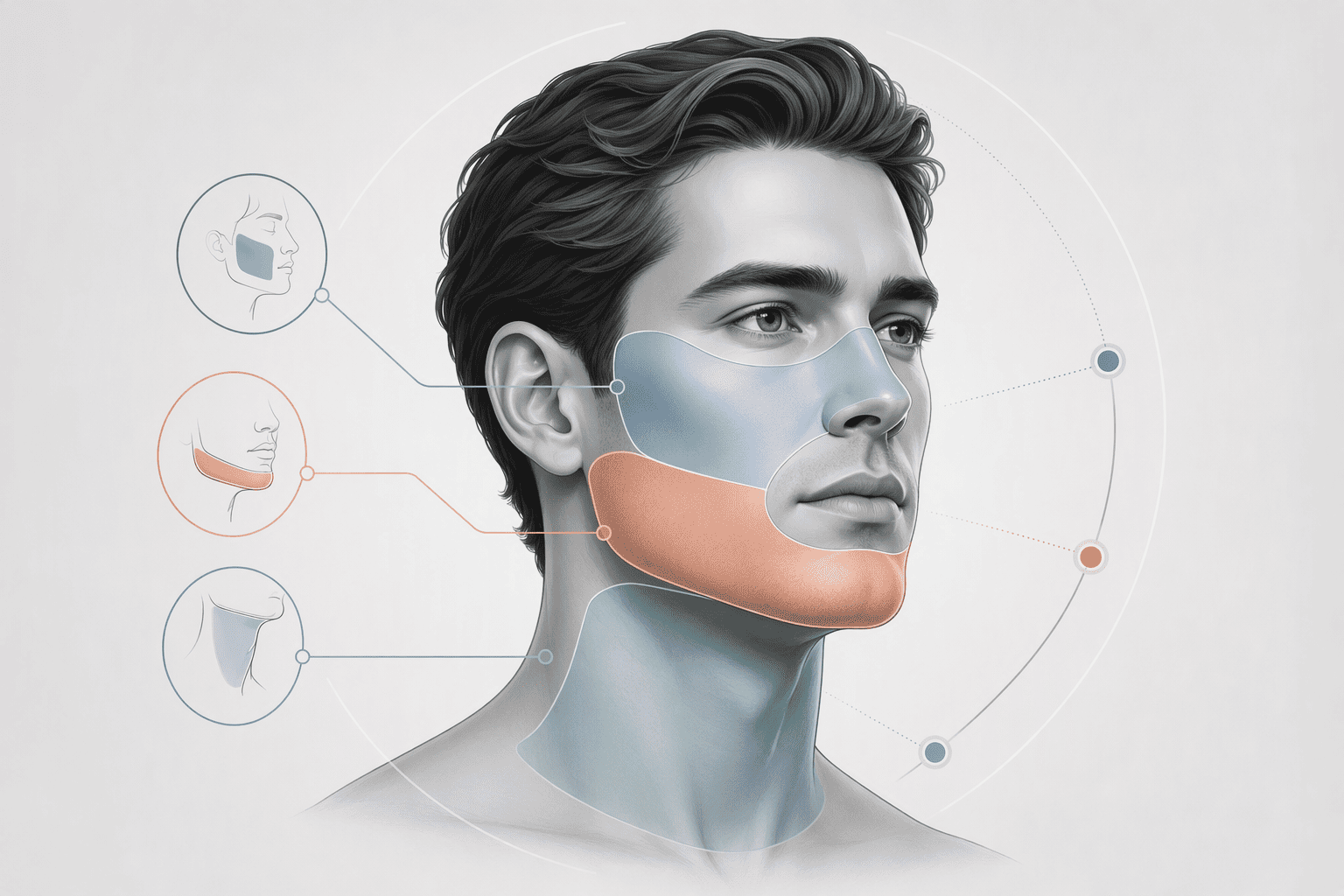
The Method Plastic Surgery starts from a simple observation: surgery and wellness are not separate disciplines. That principle matters for men, who often walk into a consultation zeroed in on one feature. They may not yet see how the jawline, midface, and neck pull on each other as a single system.
| Dimension | Dr. Paul Marji’s Approach | Standard Approach |
|---|---|---|
| Treatment philosophy | Holistic plastic surgery that balances surgical restructuring with wellness and harmony | Procedure-focused: addresses the complaint area in isolation |
| Male skin management | Personalizes tension and lift vectors to account for male skin thickness and heavier soft tissue envelope | Applies uniform technique regardless of sex, risking a tight or unnatural look |
| Structural support strategy | Emphasizes structural support beneath the skin layer to deliver a natural, masculine contour | Often relies on skin tension alone, which can fail on thicker male skin |
| Consultation depth | Uses an in-depth consultation to map precise, individualized treatment plans | Standardized consultation with templated procedure recommendations |
| Post-surgical support | Provides 24/7 support and in-person follow-ups after surgery; stitches are removed in one to two weeks | Standard office-hours follow-up with less intensive recovery monitoring |
Dr. Karan Chopra has built his practice around a single, defendable technical position: a facelift that does not address the deep plane will not hold. That is the entire thesis. Everything else is recovery logistics and scar protocols. For male patients, this matters because superficial skin-only lifts are the leading cause of the tight, stretched, feminized look men fear most.
His approach relieves tension at multiple tissue levels, including skin, SMAS (Superficial Musculoaponeurotic System), and underlying muscles. By releasing and repositioning that deeper structural layer, the skin redrapes passively rather than being pulled. The result reads as natural because it is anatomically coherent. The jawline retains its angle. The neck contour sharpens without looking waxy.
Scar management is not an afterthought. Incisions are placed strategically within the hairline and natural shadow zones of the face so they heal as light reflexes or anatomical transitions. For men, who cannot hide incisions behind longer hairstyles or makeup as easily, this is a critical edge.
Dr. Chopra’s practice also plans for what many clinics gloss over: predictable recovery. There is a one-week period of social downtime with dissolvable sutures and Tylenol-level pain management. Out-of-town patients, which Miami attracts in large numbers, receive an optional caretaker service at no additional charge. And for men who have already had a suboptimal result elsewhere, the practice offers a revision facelift to correct mistakes or missteps made by a previous practitioner.

Some men will not trust their face to a single private practitioner, no matter how accomplished. For them, the question is not which surgeon but which institution carries the most rigorous quality controls. UHealth at the University of Miami is that answer.
This is an academic medical center whose facial plastic and reconstructive surgery team is ranked in the nation’s top tier by U.S. News & World Report/facial-plastic-and-reconstructive-surgery). That ranking factors in patient outcomes, safety protocols, peer reputation, and research productivity. It is not a marketing claim.
What happens inside that system matters. The board-certified facial plastic surgeons at UHealth handle plastic and reconstructive surgeries of the face/facial-plastic-and-reconstructive-surgery), nose, ears, jaw, skin, inside of the mouth, and more/facial-plastic-and-reconstructive-surgery). For male patients, the value is the multidisciplinary structure. Facial plastic surgeons collaborate with otolaryngologists and head-and-neck specialists on every complex case. If a rhinoplasty involves a deviated septum or breathing obstruction, the airway expert is already part of the surgical plan.
The team’s scope extends beyond the routine. They manage complex male cases few private practices handle: facial paralysis reconstruction, complex nasal reconstruction, and revision work following head and neck cancer. Their aging face surgery/facial-plastic-and-reconstructive-surgery) program, which covers facelift procedures, runs on academic research protocols that private clinics do not replicate.
You will see the phrase “board-certified” on virtually every surgeon’s website in Miami. It means nothing by itself. The only question is which board.
The American Board of Facial Plastic and Reconstructive Surgery/facial-plastic-and-reconstructive-surgery) (ABFPRS) and the American Board of Otolaryngology, Head and Neck Surgery are the two that certify specific, supervised training in surgery of the face, head, and neck. The American Board of Plastic Surgery, by contrast, certifies broad training across the entire body including breast, trunk, and extremities. A general plastic surgeon might perform two facelifts a month while spending most of their schedule on body cases.
A facial plastic surgeon does only this. Dr. Carlos Wolf of Miami Plastic Surgery illustrates what this dual certification looks like in practice. He is board certified by both the American Board of Facial Plastic and Reconstructive Surgery and the American Board of Otolaryngology, and he is clinically recognized in the plastic surgery community as an expert in rhinoplasty and revision rhinoplasty.
He also holds a position as Clinical Professor at Florida International University Herbert Wertheim School of Medicine and has written columns for The Miami Herald for 15 years. That combination of facial-specific board certification, teaching appointment, and sustained peer review is the standard you want. No general board certificate replaces it.
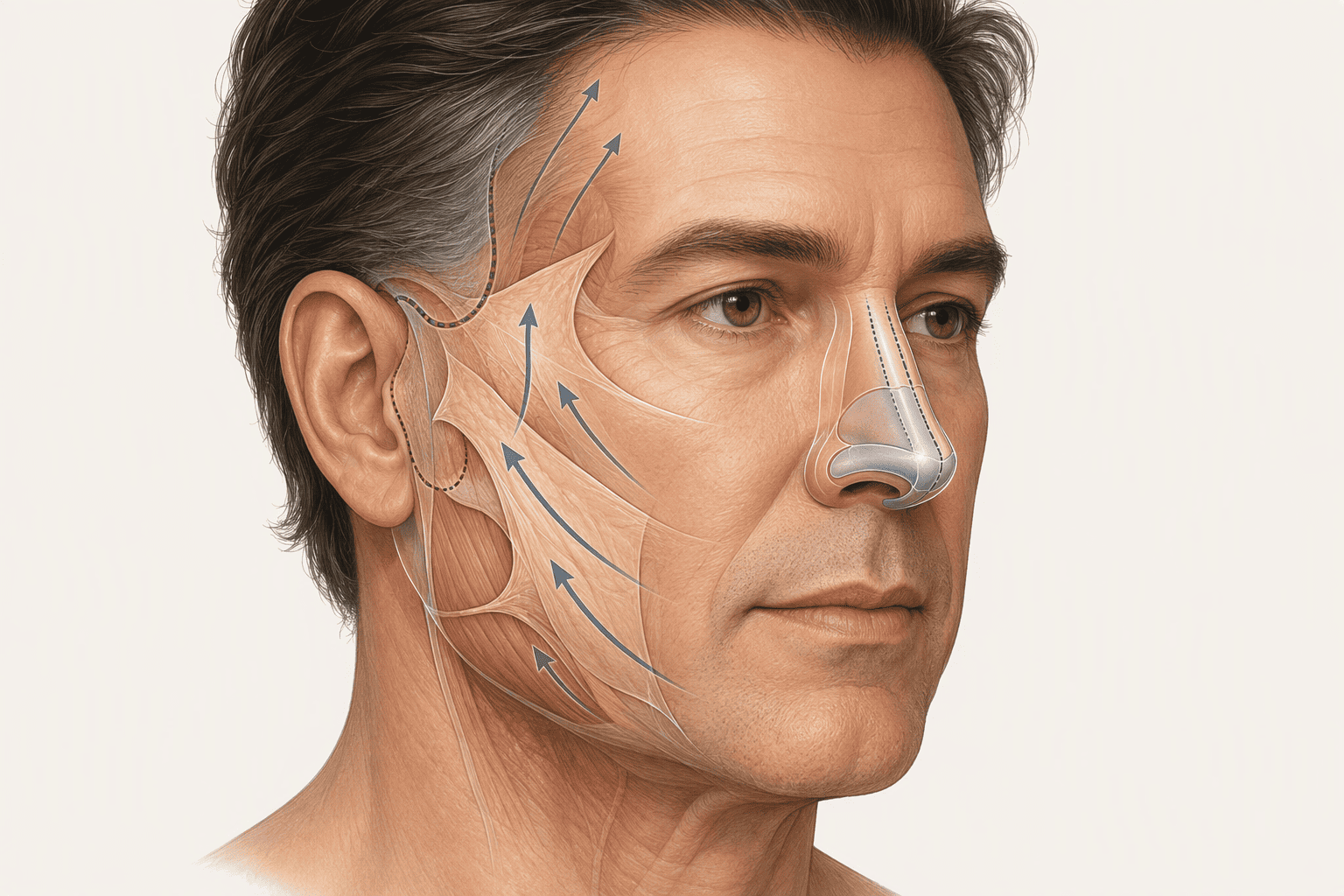
Every technical decision in male facial surgery answers one question: will this choice maintain or erase masculine facial architecture? Here are the specific elements a surgeon must execute correctly.
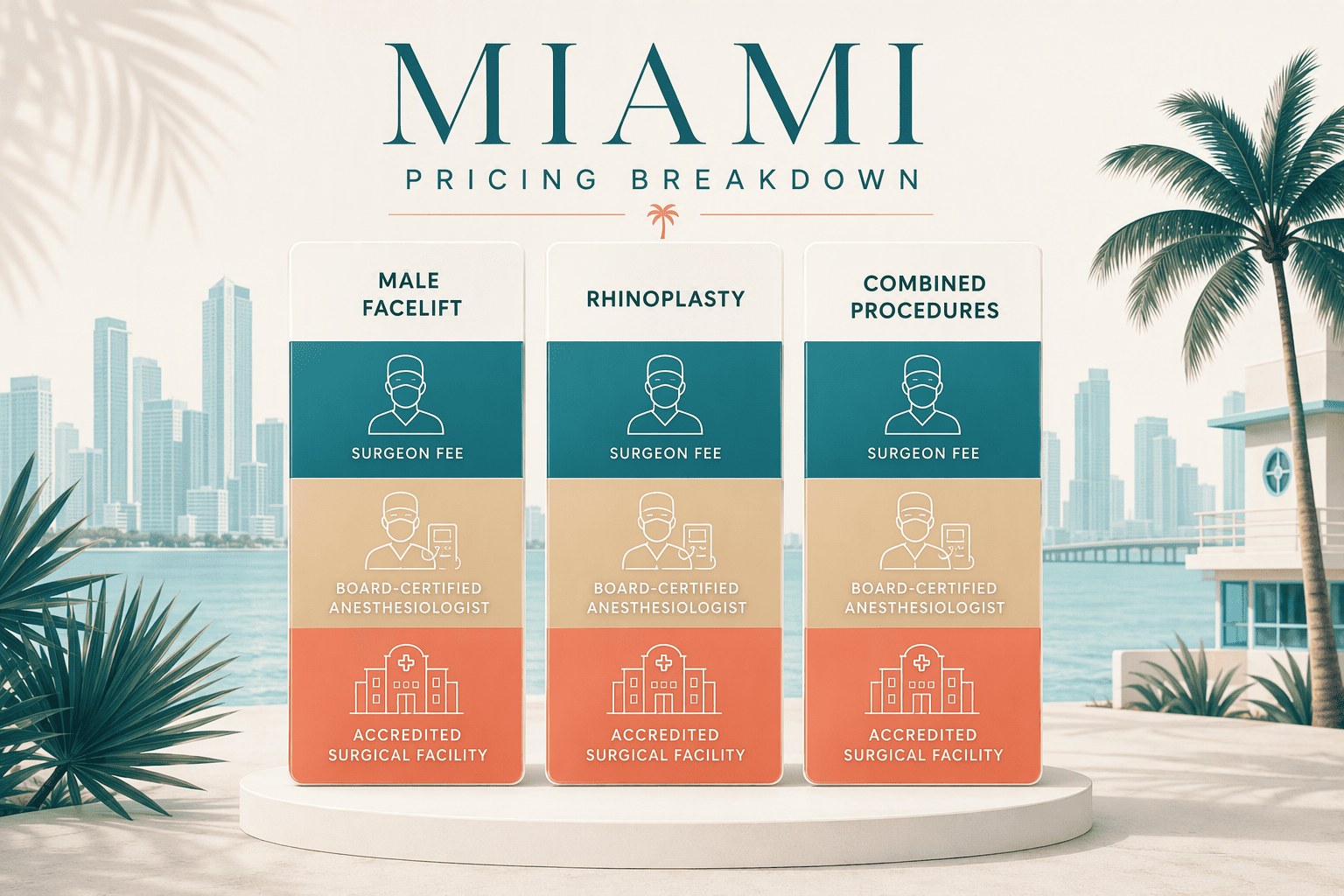
A male facelift in Miami costs $15,000 to $30,000 in 2026. Male rhinoplasty runs $8,000 to $15,000. Those numbers cover three things: the surgeon’s fee, a board-certified MD anesthesiologist, and an accredited surgical facility. When a quote comes in well under the bottom of that range, the clinic cut something. It is usually the facility (a non-accredited backroom suite), the anesthesia provider (a nurse instead of an MD), or the surgeon’s subspecialty (a generalist doing faces on the side instead of a surgeon who operates exclusively above the neck).
Combined procedures are cheaper than doing each one separately. Facility and anesthesia time overlap, so the total does not equal two full price tags stacked on top of each other. Expect a combined facelift and rhinoplasty to land between $20,000 and $40,000, with the final number driven by case complexity and total surgical time.
A consultation is not a sales presentation you sit through. It is an interview where you are the one doing the hiring. Arm yourself with these questions and do not accept vague answers.
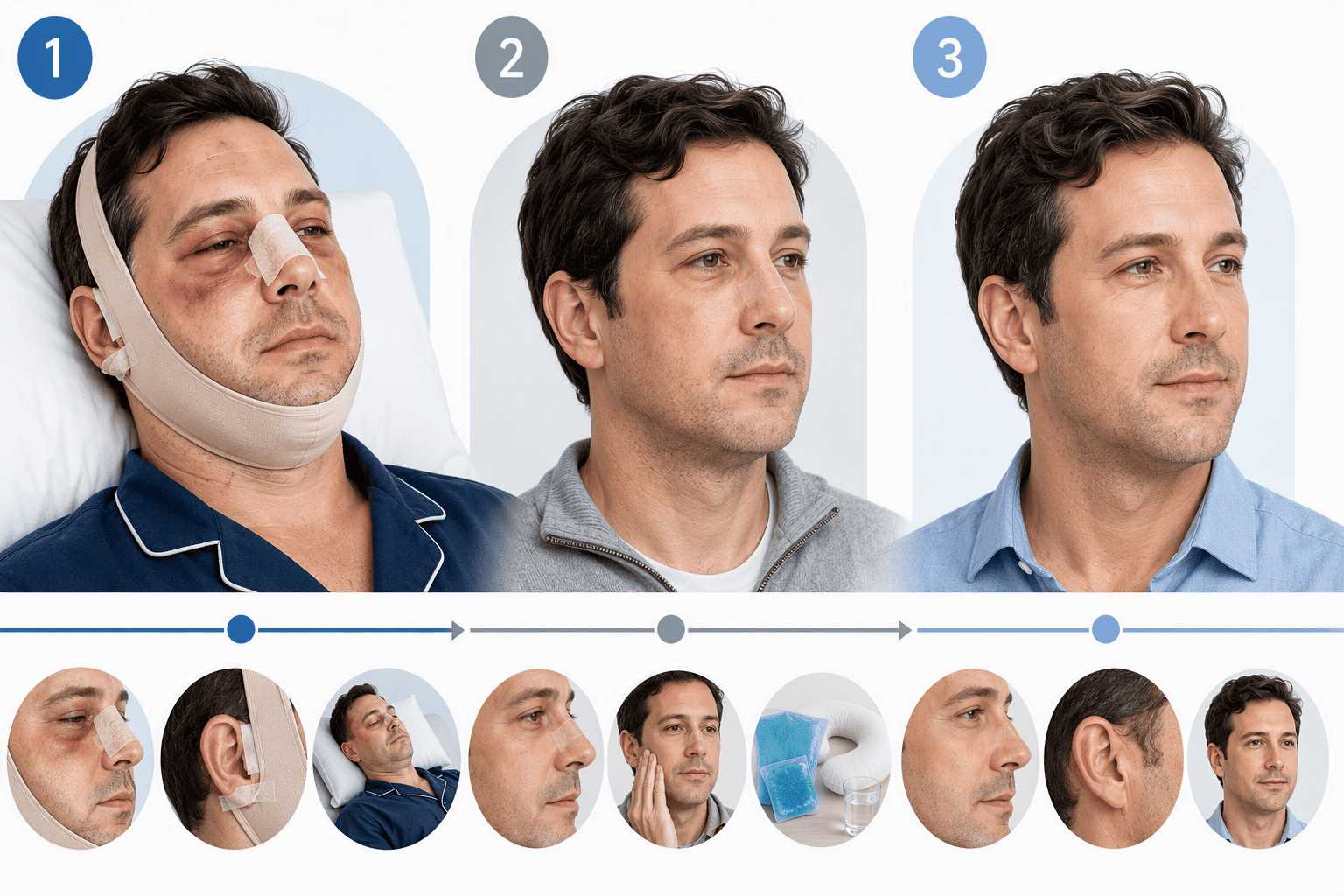
Combined recovery follows a predictable arc. Knowing the phases reduces the anxiety of returning to public life with surgical signs. Here is the timeline, day by day.
Male facial surgery fails for one of two reasons, every time. Either the board certification is inadequate, or the technique applies female aesthetic principles to male anatomy. The surgeons and institutions profiled here do not make those mistakes.
Chopra Plastic Surgery delivers the deep-plane structural approach male skin and jawlines require. UHealth offers the team-based, ranked academic rigor some men will insist on. The Method Plastic Surgery builds its plans around individual male anatomy with a holistic, structural philosophy.
Your next step is straightforward: book consultations with at least two of these practices and use the five questions from this guide. The right surgeon will answer them with specifics, not reassurances. Your face depends on it.
Follow this step-by-step process to find the right surgeon:
The American Board of Facial Plastic and Reconstructive Surgery (ABFPRS) and the American Board of Otolaryngology, Head and Neck Surgery are the two that certify focused, supervised fellowship training in the face, head, and neck. General plastic surgery board certification covers the entire body, not facial anatomy specifically.
Male facelift in Miami ranges from $15,000 to $30,000. Male rhinoplasty ranges from $8,000 to $15,000. These totals include the surgeon’s fee, accredited facility costs, and board-certified anesthesia. A combined procedure typically falls between $20,000 and $40,000.
Male facelift requires a vertical and slightly posterior vector of pull to preserve the jaw angle, careful sideburn and hairline incision placement, and neck contouring that maintains visible thyroid cartilage. Male rhinoplasty preserves a straight to slightly convex dorsal bridge and a broader, more defined nasal tip.
Ask exactly how the surgeon preserves masculine features, what their male-specific revision rate is, and to see before-and-after photos of male patients. Also ask who provides the anesthesia and whether the facility is accredited. A strong surgeon will give specific, technical answers without hedging.
Peak swelling and bruising occur in the first 48 to 72 hours. Most men return to work within 10 to 20 days. Stitches are removed in one to two weeks. Vigorous exercise resumes at four to six weeks. Final nasal refinement continues for up to one to two years.
You found a Miami surgeon whose before-and-after gallery matches what you want. The price works, the consult video felt reassuring, and you are ready to book the flight. Then a quiet thought cuts through the excitement: how do you make sure the reality matches the marketing when you live three states away?
Out-of-state surgery leaves you vulnerable because you are building a critical medical relationship at a distance, without your local support system or a facility you have walked through yourself.
The gap between a polished Instagram reel and a safe surgical experience is real, and your health can’t sit on the wrong side of it. You don’t need to scrap the idea of traveling for good care. You need a verification process that treats marketing claims as claims, not facts.
This guide covers three things you have to get right: checking your surgeon’s credentials, independently auditing the surgical facility, and nailing down recovery logistics and follow-up care before you pay a deposit.
Before you transfer a single dollar, lock down the following five verifications. A Miami plastic surgery practice that checks every box dramatically reduces your risk profile as a traveling patient.
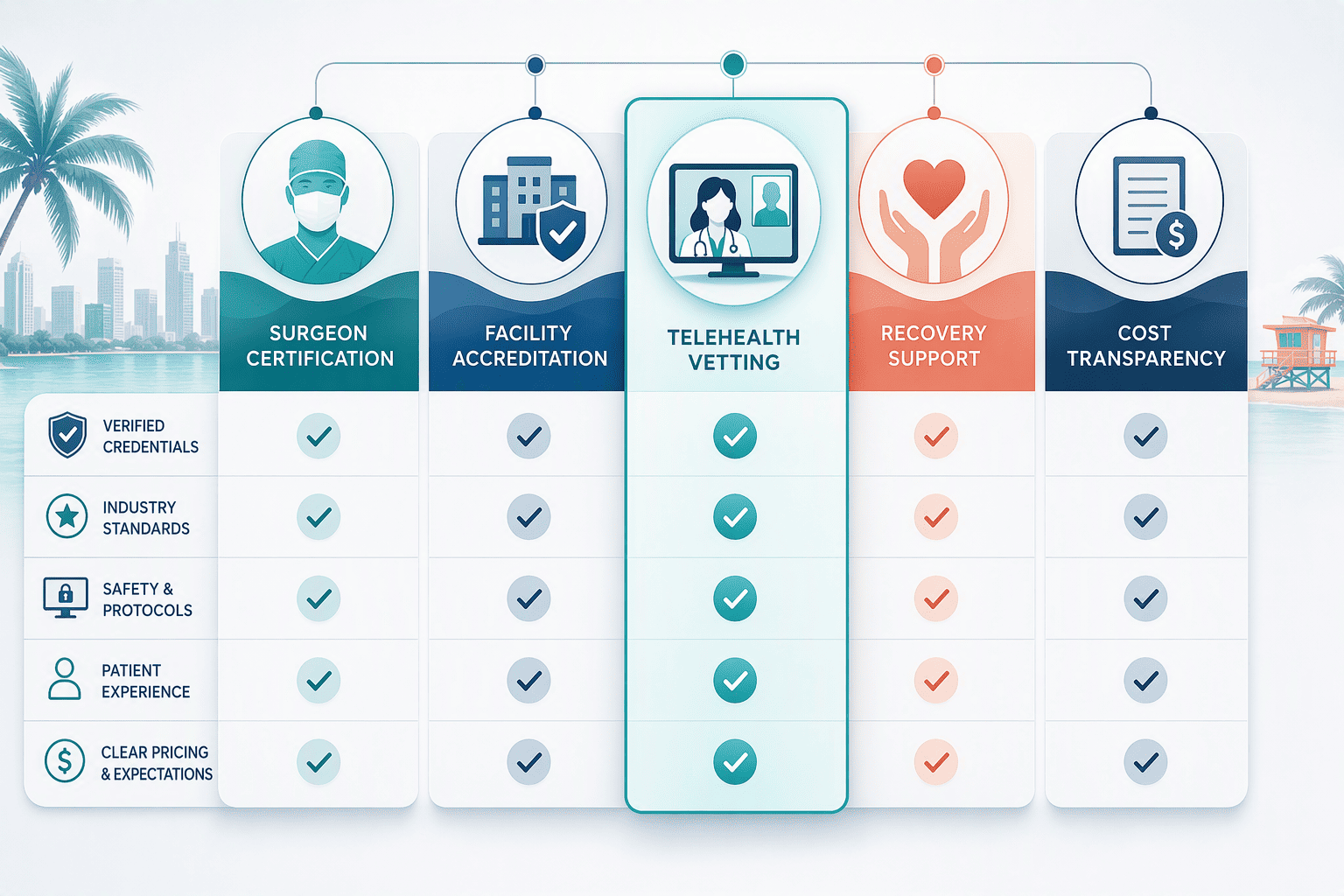
Here is how the options compare across the dimensions that matter most.
| What to Verify | Why It Matters | How to Confirm Before Traveling | Common Pitfall to Avoid |
|---|---|---|---|
| Surgeon’s board certification | Ensures specialist-level training beyond a medical license | Look up name on ABPS or ABFPRS online portals directly | Accepting a generic “board certified” claim without verifying the specific board |
| Facility accreditation | Confirms onsite safety, equipment, and emergency protocols | Ask for AAAASF accreditation certificate by name; verify online | Assuming a clinic looks clean is enough; many lack hospital-level backup |
| 24/7 recovery support | Prevents isolation if complications or questions arise after hours | Get a written policy from the practice, including who answers and how | Settling for “call our office,” which closes at 5 PM |
| Follow-up care plan | Avoids being stranded without suture removal or complication management | Request a written timeline for Miami aftercare and a transfer-of-care letter for your local doctor | Thinking you can manage everything remotely without a local provider lined up |
| All-in itemized cost | Prevents surprise bills for anesthesia, facility time, or garments | Demand a line-by-line quote that lists every fee before deposit | Relying on a single package price that adds hidden charges after booking |
The phrase “board certified” on a website means nothing until you confirm which board issued the certificate. Many traveling patients get burned by assuming any generic claim is equivalent to the gold standard. The only designations you should accept for aesthetic surgery are certification by the ABPS for body or thorough plastic surgery and the ABFPRS for facial procedures.
To cut through the noise, go directly to the source. The ABFPRS requires a surgeon to submit peer-reviewed operative reports of a minimum 100 facial plastic surgeries to even qualify, which is a level of scrutiny a state medical license does not demand. Open the ABPS and ABFPRS online verification portals and type in the surgeon’s name.
A negative result immediately disqualifies them. However, even a valid certification is not a guarantee of volume; board certification is a benchmark of excellence, but a surgeon may not frequently perform every procedure in which they trained. Ask a brutally direct question during your virtual consult: “How many times have you performed this specific operation in the last twelve months?”

An outstanding surgeon practicing in a substandard outpatient facility is a recipe for disaster you cannot afford. Hospital-level safety protocols do not automatically exist in a private clinic unless an independent body has verified them. You need evidence that your operating room passes a voluntary inspection that a standard business license does not require.
To protect yourself, visit the AAAASF website and use the “Find a Facility” tool to look up the specific clinic address on South Dixie Highway or Brickell Avenue. The accreditation status must be active and current; a lapsed certificate is a massive red flag. You also must understand the class rating. A Class A rating allows procedures under local anesthesia, but a Class B or C accreditation is required if your operation involves deep sedation or general anesthesia, which most thorough body contouring and facial surgeries demand. Outpatient surgery safety hinges on this distinction, and confirming it removes the risk of being operated on in a room that was never vetted for the depth of anesthesia you will receive.
A video call is your primary tool to sniff out a generic surgical mill from a practice that operates with precision. Most virtual consultations for plastic surgery slide into a sales pitch; you can flip that by running the meeting on your terms. Ask for something real that proves clinical competence, not a slick slide deck.
When you’re on the screen with the coordinator or surgeon, tell them to turn the camera around and give you a live walkthrough of the accredited operating room and recovery suite. Direct them to show you the anesthesia machine, the backup power systems, and the sterile processing area right then. How they handle that request tells you everything about how open they actually are.
After the tour, get specific about your case. Skip “Do you do liposuction?”
and ask for the exact tumescent technique and the brand of cannulas they use for Lipo 360 at the Miami clinic. Some practices, like The Method Plastic Surgery, walk through their specialized clinic setup for procedures such as liposculpture during a detailed consultation; press them to show you the device itself so you can check a “state-of-the-art technology” claim with your own eyes.
Shift the focus from equipment to results by asking for hard numbers. When they describe a fat transfer method like pairing Lipo 360 with a BBL, ask which graft preparation system they use, such as SmartGraft, to improve fat transfer results, and then ask what percentage of fat cell viability they expect based on their own audit of past cases. A surgeon who gives you a tight, candid estimate is working from a real track record, not a script. Vague, aspirational answers are a reason to walk away.

The greatest danger for an out-of-state patient isn’t the surgery. It’s the first 72 hours afterward, alone in a hotel room with no one who knows your chart.
Your recovery plan needs to be infrastructure you’ve already paid for and confirmed, not a list of numbers you might call. Get a hard commitment for direct-dial, 24/7 access to a medical professional who has your operative report. A practice that sends you to a general answering service, or a third-party nursing line with no real-time view of your file, hasn’t met the bar.
Distance between your bed and the clinic matters sharply in Miami. A seroma or a hematoma that needs attention at 11 p.m. can’t wait on a rideshare crawling through traffic. The setup you want is a recovery house or hotel suite inside a ten-minute radius, with in-person follow-ups already on the calendar.
Confirm the lodging lets you stay put for the minimum required time. Major body contouring means staying in the area one to two weeks, at least until a qualified provider clears you for suture removal. Before you book a flight, ask for the specific staffing protocol.
Reputable groups keep skilled medical staff close and give you a direct line after surgery, but you need that defined in writing. A verbal promise of round-the-clock support doesn’t hold up at 2:00 a.m. when you spike a fever. Insist on a document that states a physician or registered nurse stays on-site or on immediate call to your recovery location, and that you won’t be routed through a telehealth portal during an emergency.
UHealth’s plastic surgery team puts it plainly: comfort and trust drive a healthy, fast recovery. That standard rests entirely on physical access during the window when things are most likely to go wrong.
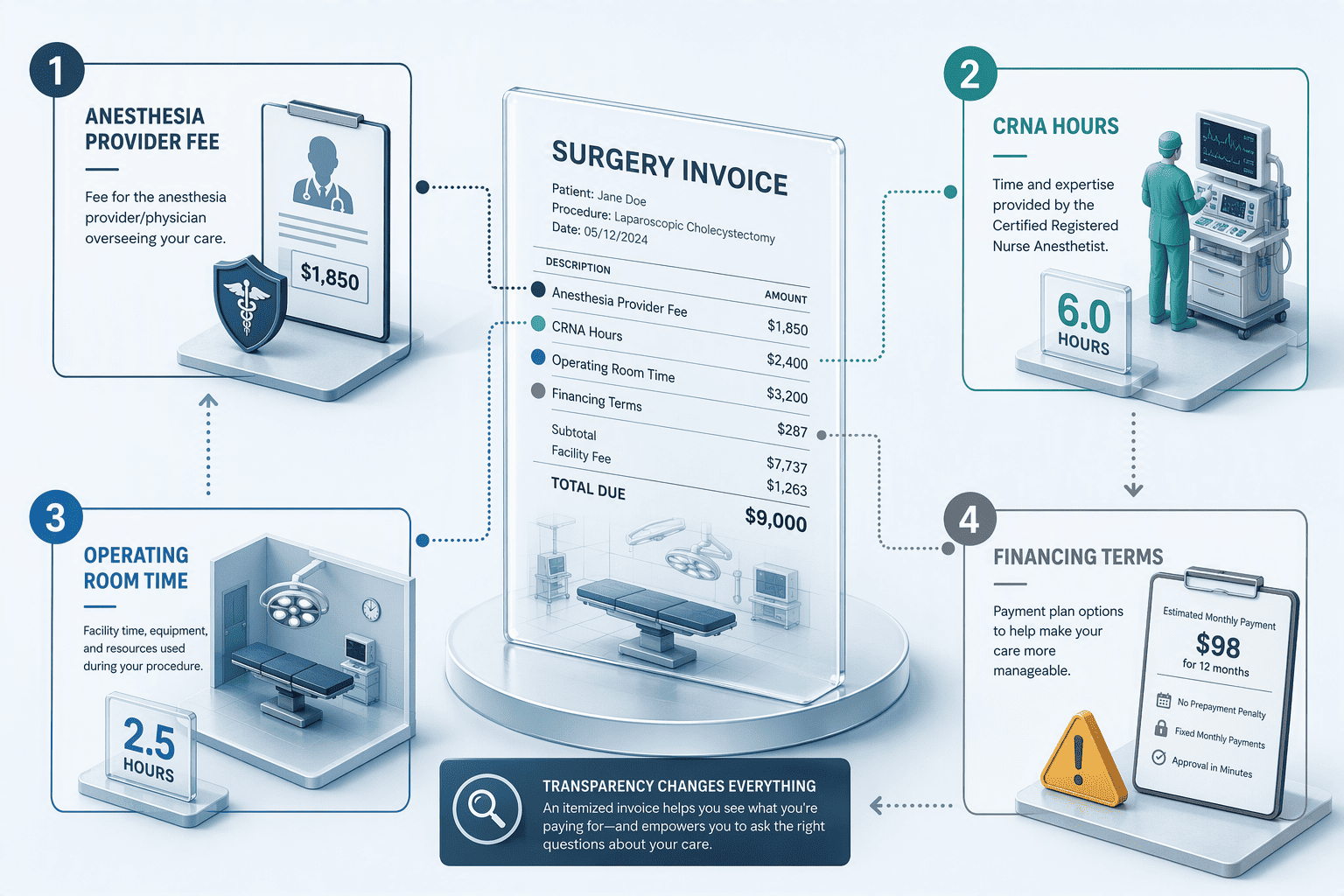
You need to view the quote through a lens of line-item skepticism, pulling every ancillary expense out of the shadows before your trip.
A clean surgical handoff is the only mechanism that prevents you from becoming a medical orphan when you land back at your home airport. While your Miami surgeon handles the primary procedure, your local provider must be the designated partner for late-onset infections, seromas, and final aesthetic assessment. Secure this handoff agreement in writing before scheduling surgery.
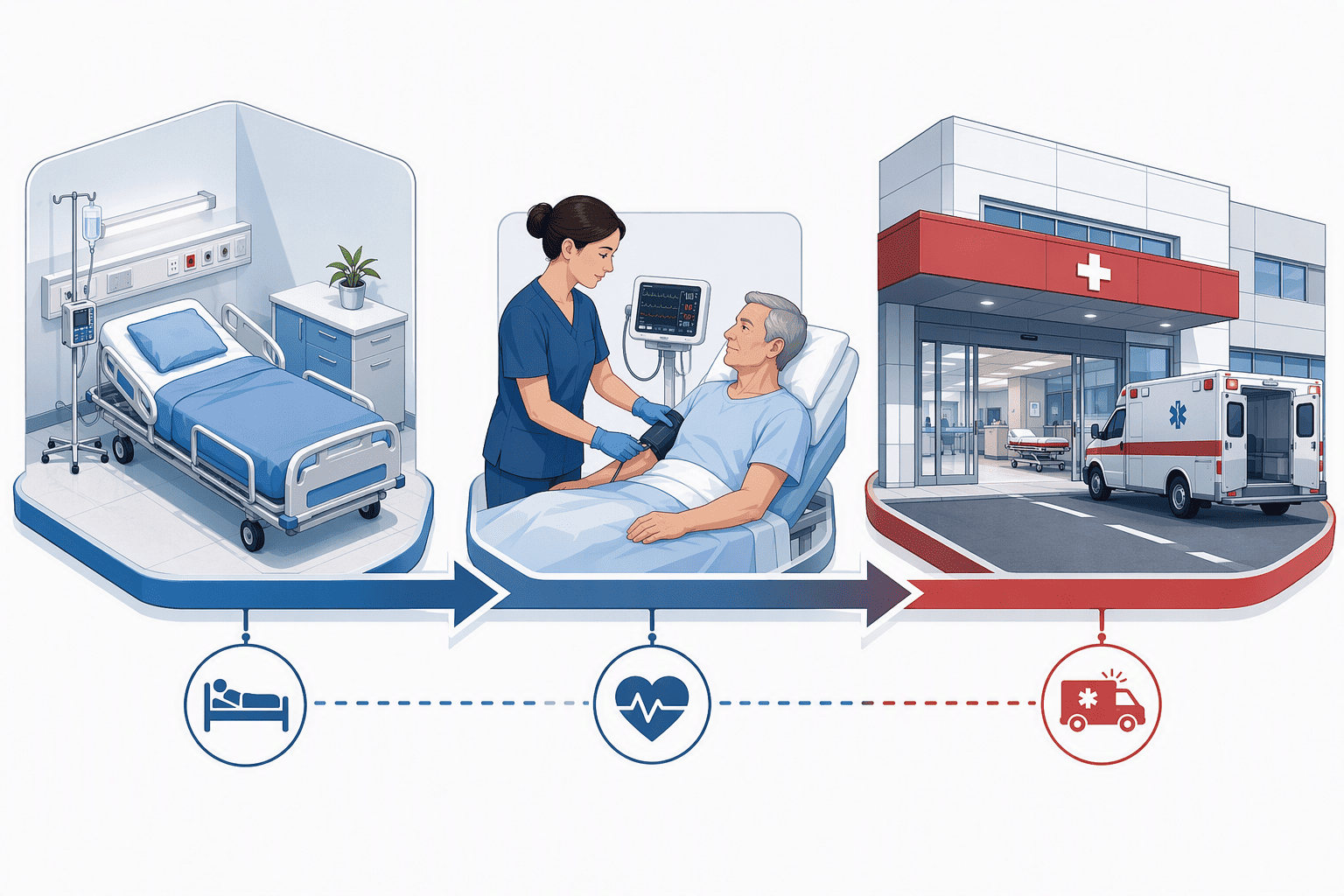
Skipping the mental run-through of a complication is the most dangerous move a medical tourist can make. You aren’t being morbid when you trace the route from your recovery bed to a hospital emergency department. You are checking whether the clinic has actually prepared for the worst, and that question needs an honest answer before sedation strips you of the ability to ask it. By 2014, roughly 65% of all surgical procedures were already happening on an outpatient basis, so protocols for managing a crisis outside a hospital are what your safety actually rests on.
Learn the concrete symptoms of a deep vein thrombosis: a calf that turns painful and swollen. For a pulmonary embolism, you are looking for sudden shortness of breath and chest pain. Demand that your surgeon give you their infection rate directly, and ask for the step-by-step protocol they would use to transfer a deteriorating patient to a facility like the University of Miami Health System.
The UHealth plastic surgery team holds board certification and handles complex reconstruction cases. That makes it a logical emergency backstop when a private-practice procedure goes wrong. After that planning, turn your travel timeline into a medical calculation.
For any thorough abdominal or facial surgery, book a minimum of two weeks on the ground before you fly. Cabin pressure changes and hours of sitting during the early post-inflammatory window raise your DVT risk sharply. If you notice redness creeping past the incision or a fever that ticks above 100.4°F, that return flight is medically unsafe.
Traveling for surgery pulls apart the usual safety layers that catch problems early, but that does not mean you lose control of the outcome. Independent ABPS and AAAASF verification, a recovery plan built into the process, and a signed continuity-of-care agreement give you a real safety mechanism. You cannot hand your trust to a social media feed or a price quote, but you can verify your way into an operating room where the surgical data matches the promise. Run the checklist, and let the objective confirmation of safety, not the emotional pull of a sales pitch, make the final call on your travel.
Verify active certification from the American Board of Plastic Surgery (ABPS) or the American Board of Facial Plastic and Reconstructive Surgery (ABFPRS) on their official online portals. A state medical license is not a substitute for these rigorous, peer-reviewed benchmarks of surgical excellence.
Use the AAAASF website’s “Find a Facility” search to confirm the surgical center holds a current and active accreditation. You must also verify the class rating, ensuring it is at least Class B or C if your procedure requires deep sedation or general anesthesia.
Book a recovery house or hotel within ten minutes of the clinic, pre-schedule a dedicated aftercare nurse, and secure a written commitment for 24/7 direct-line access to a medical professional. Isolation in a remote hotel is the highest-risk variable for a traveling patient.
Male enhancement can generally range from about $1,000 to $25,000 depending on complexity, but this often excludes anesthesia, OR time, and post-op garments. Always demand an itemized invoice separating the surgeon’s fee from facility costs, implant charges, and recovery supplies.
Plan for a minimum two-week post-operative stay in Miami before flying to reduce the risk of a deep vein thrombosis (DVT). Primary risks include infection and seroma formation; you must delay your return flight indefinitely if you develop a spreading redness or a fever above 100.4°F.
Request a live video walkthrough of the accredited operating room to see the equipment in real time. Ask for the specific model of surgical cannulas or fat-grafting systems used and demand data on the surgeon’s personal complication rate and annual volume for your exact procedure.